
Long-Distance Network Deployment: PoE Media Converters vs. Traditional Media Converters
Copper Ethernet cable tops out at 100 meters before signal quality starts to drop off, and that limit becomes a real problem the moment a campus network, a transportation corridor, a security system, or an industrial site needs to reach devices hundreds of meters — or several kilometers — away. Fiber optic cable solves the distance problem, but fiber and copper Ethernet speak different physical languages, so something has to bridge them. That's where a media converter comes in.
The core question this article answers is this: when a remote device needs to connect to a fiber network, should the deployment use a PoE media converter, which transmits data and power together, or a traditional media converter, which handles only photoelectric conversion? As the sections below show, the answer depends less on distance and more on how the remote endpoint gets its power.

The Role of Media Converters in Long-Distance Network Deployment
A media converter's basic job is converting signals between fiber optic cable and copper Ethernet. Because that basic function is identical across both types, the deployment decision really comes down to one thing: whether the connected device also needs power.
The Role of PoE Media Converters in Long-Distance Network Deployment
A PoE media converter converts fiber optic signals into copper Ethernet signals and, at the same time, delivers electrical power to the remote device over that same Ethernet cable. Data and power travel together, which means the deployment no longer needs a separate power outlet or dedicated power run at the far end.
This capability matters most where the endpoint sits away from any electrical infrastructure. IP cameras, wireless access points, and VoIP phones are the clearest examples: each draws modest power, yet each is often mounted somewhere that running a power line would be slow, costly, or simply impractical.
The Role of Traditional Media Converters in Long-Distance Network Deployment
A traditional media converter performs the identical fiber-to-copper conversion but stops there — it does not push power out through the Ethernet port. Consequently, it only makes sense where the connected equipment already has its own power supply nearby.
That's exactly the situation in switch-to-switch interconnection, building-to-building fiber links, and general industrial network expansion, where both ends of the connection are already wired into mains power well before the converter is added.
Key Differences Between PoE and Traditional Media Converters
With the basic roles established, the more useful comparison is where the two approaches actually diverge — in power delivery, installation, cost, and standards compliance.
Power Delivery and Data Transmission
The core distinction is straightforward: a PoE media converter transmits both power and data over a single Ethernet cable, whereas a traditional media converter handles data transmission only. Both extend Ethernet transmission distances through fiber, so the primary difference lies not in the fiber transmission itself, but in the capability to provide remote power.
Cabling and Installation Requirements
That difference in power delivery carries straight through to installation. PoE solutions eliminate the need for a separate power installation near the endpoint, which simplifies the deployment of remote cameras and wireless access points. Traditional solutions, by contrast, require local power adapters, power outlets, or additional power lines at the remote end.
For devices that already have a power source, though, traditional converters may offer the simpler setup, since there's no PoE budget to calculate and no standard to verify.
Equipment Cost and Total Deployment Cost
Installation complexity feeds directly into cost. The unit price of a PoE media converter is often higher — Wintop's PoE media converter lineup illustrates the trade-off well, as the WT-P8100G pairs one 10/100/1000Base-T port with one 1000Base-FX fiber port, supports the IEEE 802.3af/at standard, and includes a link-failover function for added reliability.
That higher unit price, however, often reduces costs associated with power cables, power outlets, electrical installation labor, remote power equipment, and ongoing maintenance points. Traditional converters may have lower equipment costs, but the decision should be based on the total infrastructure cost rather than the price tag on the converter alone.
PoE Standards and Device Compatibility
Getting that cost comparison right, in turn, depends on matching the converter to the correct PoE standard for the job. Three IEEE standards currently define how much power a PoE port can deliver: IEEE 802.3af, IEEE 802.3at, and IEEE 802.3bt, each covering a progressively higher power ceiling.
Before finalizing a converter, it's worth confirming which standard the endpoint device actually expects, the port's rated output power, the power budget genuinely available after other loads are accounted for, and how much power is lost over the length of the cable run itself.
Network Design and Deployment Flexibility
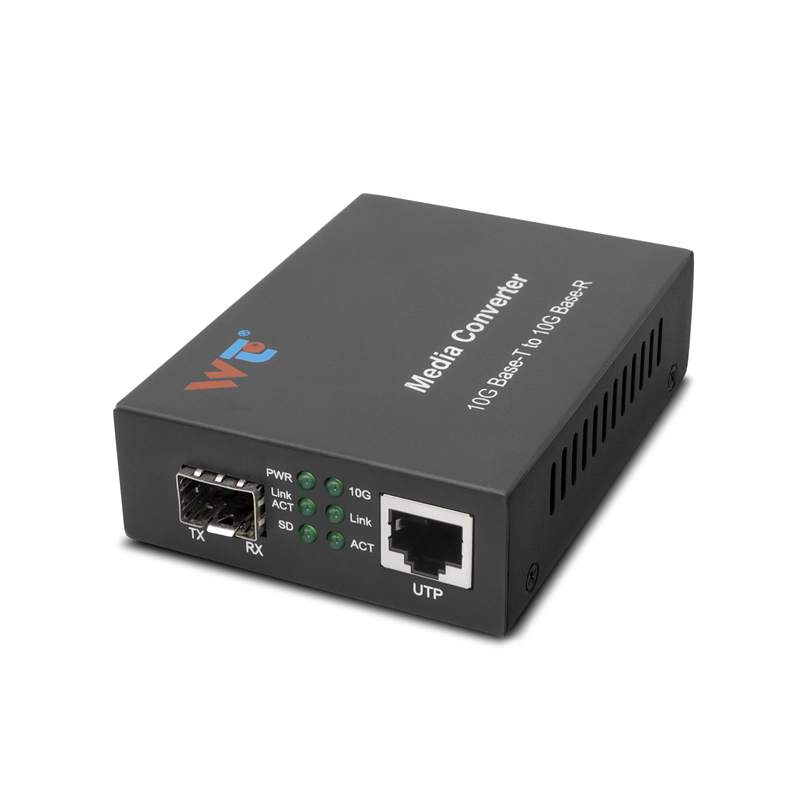
Put together, these differences settle into a fairly clean design principle. A PoE media converter suits remote nodes that have no power source of their own, while a traditional converter offers more flexibility and a lower cost wherever the device already has power and needs only optical-to-electrical conversion. Wintop's 10G media converter category is built with exactly that second scenario in mind, aimed at high-throughput links between switches and servers that are already powered.
Key Factors in Choosing a Media Converter for Long-Distance Deployment
With the core differences in mind, a few practical factors determine which converter actually fits a given deployment.
Remote Power Availability
This is the primary factor to consider. If there is no reliable power source at the remote location, a PoE media converter is usually the better choice; if stable power is already available, PoE functionality may not be necessary.
Endpoint Type and Power Requirements
Beyond power availability, it's worth assessing the endpoint device itself, such as:
IP surveillance cameras
Wireless access points
VoIP phones
Industrial controllers
For PoE-enabled endpoints, it's important to verify that the device's power requirements do not exceed the converter's output capacity.
Bandwidth and Port Speed Requirements
Alongside power, bandwidth needs to be selected based on network traffic:
10/100 Mbps
Gigabit Ethernet
2.5G or 10G Ethernet
Factors influencing the choice of port speed include the number of security cameras, video resolution, wireless access point throughput, and uplink traffic volume. Wintop's WT-8100W addresses the higher end of this range, providing one 10-Gigabit optical port paired with a 10-Gigabit adaptive electrical port that auto-negotiates from 1000Base-T through 10GBase-T.
Fiber Type and Transmission Distance
Bandwidth choices in turn depend on the fiber link itself. Considerations include:
Single-mode or multimode fiber
Connector type
Wavelength
Maximum transmission distance
Single-fiber or dual-fiber transmission
Fiber parameters and optical modules at both ends of the link must match, or the connection will not establish properly.
Environmental Reliability
Finally, for outdoor, transportation, power utility, and industrial settings, it's also worth considering:
Wide operating temperature
Surge protection
Redundant power inputs
DIN-rail mounting
Industrial enclosure
Link fault pass-through
The WT-8100W's -20°C to 60°C operating range and -40°C to 85°C storage rating reflect this kind of margin for field conditions.

Best-Fit Applications for Each Media Converter Type
Putting these factors together in practice, each converter type tends to cluster around a distinct set of applications.
PoE Media Converters for Remote Unpowered Endpoints
Suitable applications include roadside surveillance cameras, perimeter security systems, parking facilities, and industrial monitoring endpoints. These scenarios often involve long distances and difficulty accessing reliable power near the endpoint, which is exactly where a PoE media converter earns its keep.
Traditional Media Converters for Locally Powered Equipment
By contrast, suitable applications for traditional converters include outdoor wireless access points, remote access-control devices, connections between Ethernet switches, building-to-building network links, factory equipment with local power, legacy Ethernet network extensions, and fiber connections to powered control cabinets. When equipment already has a local power source, traditional converters avoid unnecessary PoE costs and configuration complexity.
PoE Media Converter vs. Traditional Media Converter: Selection Summary
Bringing all of this together, the table below summarizes how the two approaches compare across the factors discussed so far.
Selection Factor | PoE Media Converter | Traditional Media Converter |
Fiber-to-Ethernet conversion | Yes | Yes |
Power over Ethernet | Yes | No |
Local power required for endpoint | Usually no | Yes |
Cabling complexity | Lower | Higher when power wiring is needed |
Initial device cost | Usually higher | Usually lower |
Best application | Remote PoE endpoints | Locally powered Ethernet devices |
As a fiber media converter manufacturer with more than two decades of production experience, Wintop backs its converter range with ISO 9001 quality management and rigorous three-stage testing on every unit, and supports OEM and ODM customization with flexible MOQ for integrators with project-specific requirements. The full range — from the 100M media converter series for lightweight links to 10G models for backbone aggregation — is organized around exactly the power, speed, and environment factors covered above.
After weighing the table above, the decision usually comes down to a short checklist:
Remote device requires PoE power: choose a PoE media converter
Remote device already has a power source: choose a traditional media converter
Harsh environment: prioritize industrial-grade models
High bandwidth requirements: verify port speed, fiber type, and uplink capacity

Conclusion: Matching the Media Converter to the Deployment
Neither option is universally better. The main advantage of PoE media converters is simplified remote power delivery and cabling, while the advantage of traditional media converters lies in their simple architecture and lower cost — an advantage that suits deployments where power is already in place.
In the end, the final choice should depend on remote power availability, endpoint type, PoE power requirements, bandwidth, fiber distance, and environmental conditions, not on unit price alone. Put simply, the right media converter is determined not only by transmission distance, but also by how the remote endpoint is powered, connected, and maintained.