
Why Your Network Hits a Wall — And How SFP RJ45 Transceivers Fix It
Industrial networks rarely fail all at once — they hit a wall gradually, as more copper-based devices need to join a fiber backbone that was never built to accept them. This piece looks at why that mismatch happens and how an SFP to RJ45 transceiver resolves it without a network redesign.
What’s Actually Choking Your Industrial Network?
Most industrial networks hit a wall because two connector types have to coexist under one roof, and they were never designed to. Fiber switches speak one language; copper-based cameras, controllers, and monitoring devices speak another. Therefore, every mixed deployment eventually runs into a physical mismatch that no amount of configuration can fix on its own.
Why Do Copper and Fiber Segments Clash in the Same Deployment?
A switch equipped with an SFP or SFP+ port normally relies on a compatible transceiver to determine the physical media used for the connection. If the installed module provides a fiber interface but the endpoint uses RJ45 copper Ethernet, a direct physical connection is not possible. As a result, a copper-only device — a PLC (programmable logic controller), an IP camera, or a legacy RTU (remote terminal unit) — cannot plug directly into a fiber-ready switch port. For example, a substation control room might run a fiber ring backbone while field-level relays still terminate in RJ-45. Without a bridging component, that gap forces engineers to run separate cabling paths or add a full media-converter chassis just to connect one device.
What Happens When Cabling Distance Outgrows Your RJ45 Ports?
Cabling distance becomes a wall when a copper run needs to stretch further than a standard RJ-45 uplink was ever rated for. Native copper Ethernet ports are tied to fixed distance and speed ceilings set by the cabling grade. Consequently, contractors extending a network across a large substation yard, a rail corridor, or a factory floor often discover that the switch closet is too far from the edge device. This is exactly the scenario where a pluggable module, rather than new trunk cabling, becomes the more practical fix.
What Is an SFP to RJ45 Transceiver, and How Does It Solve This?
An SFP to RJ45 transceiver is a small pluggable module that snaps into a standard SFP cage and converts the switch’s SERDES interface into a standard RJ-45 copper port. Because it follows the SFP MSA (Multi-Source Agreement) footprint, it works as a drop-in module rather than a separate box.
How Does an SFP to RJ45 Transceiver Bridge Fiber Switches and Copper Devices?
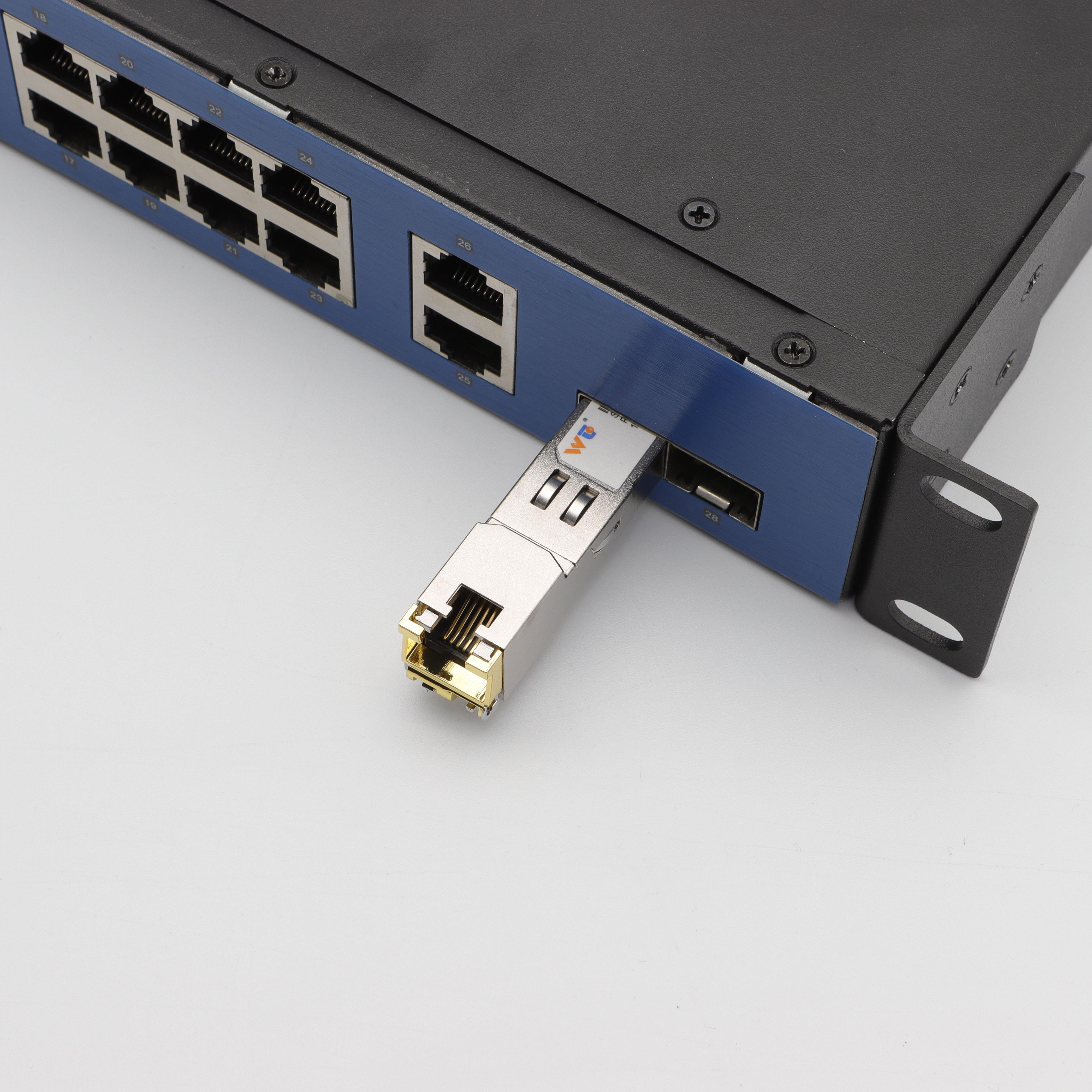
An SFP to RJ45 transceiver bridges the two worlds by handling the electrical-to-SERDES conversion internally, on the module itself. The switch simply sees another populated SFP port. Therefore, integrators don’t need to redesign the rack, add a separate converter unit, or run new fiber to reach a copper-only endpoint — they insert the transceiver and patch in a standard Ethernet cable.
What Makes WINTOP’s SFP-T Copper RJ45 Transceivers Built for Industrial Sites?
WINTOP’s SFP-T Copper RJ45 Transceiver line is built around this bridging role, drawing on the company’s 21 years in fiber-optic network equipment and more than 1,000 smart substation deployments across 40-plus countries. Both models in the line are hot-pluggable, carry RoHS compliance and are rated for 0°C to +70°C ambient operation, making them suitable for deployments where this temperature range can be maintained. Beyond the RJ45 line, WINTOP’s broader industrial network equipment catalog covers switches and media converters for the same vertical markets, which matters when a project needs matched components from one traceable supplier.
| Attribute | WINTOP WT-SFP-T (1000Base-T) | WINTOP WT-SFP+-T (10G) |
|---|---|---|
| Line-port speed | 10/100/1000Base-T | 10G/5G/2.5G/1000Base-T |
| Host interface | SERDES | 10GBase-R |
| Cable type | Cat5 | Cat6a |
| Warranty | 3 years | 3 years |
1000Base-T SFP Transceiver or 10G SFP to RJ45 — Which Do You Need?
Choosing between the two models comes down to what the edge device actually needs, not which spec sheet looks more capable.
When Should You Choose a 1000Base T SFP Transceiver?
A 1000Base-T SFP transceiver fits any deployment where the connected device — a camera, a sensor gateway, an access switch — tops out at gigabit speed anyway. Because the WINTOP WT-SFP-T supports 10/100/1000Base-T operation, it can be used with copper Ethernet connections at different supported speeds. For instance, most security cameras and industrial IoT sensors in smart-city and petrochemical monitoring networks never exceed 1Gbps, so paying for 10G capacity there adds cost without adding usable throughput.
When Does a 10G SFP to RJ45 Transceiver Make Sense?
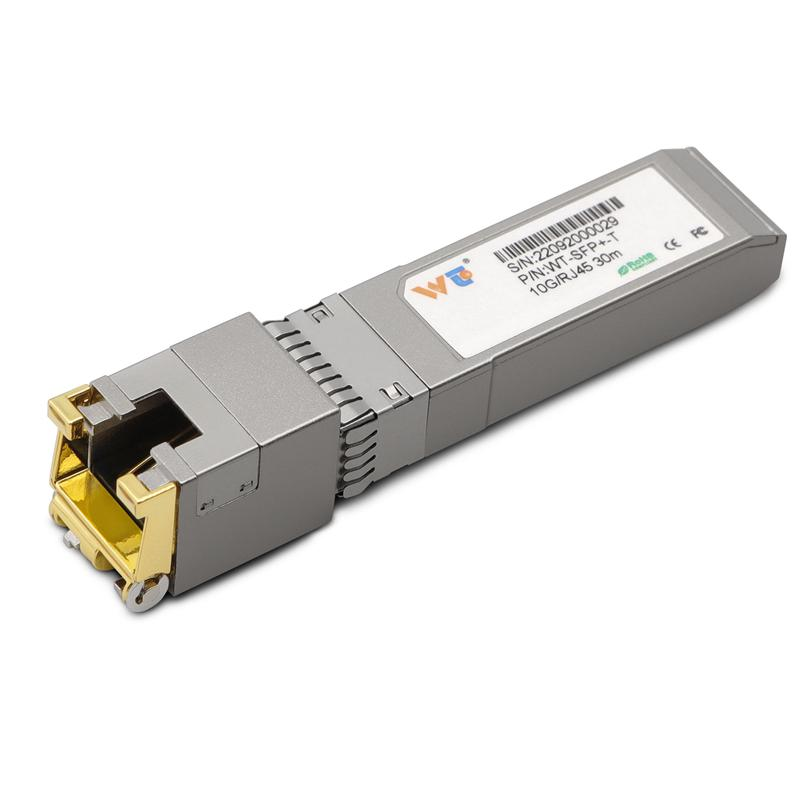
A 10G SFP to RJ45 transceiver makes sense once the link itself is the bottleneck — typically an aggregation point, a server rack, or a data-center interconnect. The WINTOP WT-SFP+-T supports 10GBase-T, 5GBase-T, 2.5GBase-T, and 1000Base-T on the line side, making it suitable for mixed-speed Ethernet deployments where different copper link speeds are required. As a result, one 10G SFP to RJ45 module can serve a mixed-speed deployment as equipment gets upgraded over time, instead of forcing a rip-and-replace.
How Do SFP to RJ45 Transceivers Support Ring Redundancy and Industrial Protocols?
Redundancy and protocol support matter more in industrial networks than in office IT, because a dropped link at a substation or a rail signal point isn’t just inconvenient — it can halt operations.
How Do They Fit Into Ring Network Redundancy for Substations and Rail Signaling?
The transceiver does not itself perform ring-protection functions. Instead, it provides the copper Ethernet interface required by the endpoint, while ring redundancy is handled by the connected network switches and their supported protocols, such as RSTP (Rapid Spanning Tree Protocol) or ERPS (Ethernet Ring Protection Switching). Because the module doesn’t add switching logic of its own, it doesn’t introduce a new point of failure into the ring’s convergence time. For example, in a substation ring where fiber forms the backbone and RJ-45 devices sit at the edge, the transceiver lets that edge device join the ring without altering the ring’s failover behavior.
Can They Be Centrally Managed and Monitored?
Link status and module presence are visible to the host switch through standard SFP signaling, including RX_LOS (loss-of-signal indication) on the WINTOP WT-SFP+-T. However, detailed diagnostics — such as digital optical monitoring — depend on what the connected switch platform exposes; the transceiver reports status, and the switch’s management software is what surfaces it to an operator.
How Do These Transceivers Fit Across Different Industrial Verticals?
The same bridging role plays out differently depending on the environment:
| Vertical | Typical Copper-to-Fiber Scenario |
|---|---|
| Electric Power & Energy | Substation control rooms mixing fiber rings with copper-terminated relays and RTUs |
| Rail Transit | Signal monitoring points along a corridor where copper sensors need to reach a fiber-backboned network |
| Smart City | Security cameras and IoT devices on copper drops feeding into a fiber aggregation switch |
| Petrochemical | Industrial monitoring systems where existing copper Ethernet connections need to interface with a fiber-based network |
| Smart Manufacturing | Factory-floor automation controllers on copper links joining a fiber-based plant network |
| Data Center | Rack-level 10G copper interconnects feeding into fiber-based core switching |
These are illustrative deployment patterns based on the verticals WINTOP serves, not documented case studies with published results.
What Should You Check Before Ordering an SFP RJ45 Transceiver?
Getting the module right on the first order avoids downtime and return shipping later.
What Compatibility Checks Should Integrators and OEMs Run First?
Integrators should confirm three things before ordering: the switch brand’s SFP compatibility list, the required line-side speed, and the operating temperature range against the install site. WINTOP lists Cisco, H3C, and Huawei compatibility for the WINTOP WT-SFP+-T, and Cisco, HP, H3C, and Huawei for the WINTOP WT-SFP-T. OEM and ODM customers with different requirements can request customized configurations rather than assuming a stock module will match every platform.
What Cabling and Installation Details Affect Real-World Performance?
Cable grade is the detail most often overlooked. The WINTOP WT-SFP-T is rated for Cat5 at gigabit speeds, while the WINTOP WT-SFP+-T requires Cat6a to reach its full 10G line rate. Therefore, running the WINTOP WT-SFP+-T over older Cat5e cabling may limit performance below its full 10G potential, since the module's rated speed assumes Cat6a-grade cabling.
Is an SFP to RJ45 Transceiver the Right Fix for Your Network Wall?
If your network wall is a copper-to-fiber mismatch, a distance limitation, or a mixed-speed edge device that needs to join a fiber backbone, an SFP-to-RJ45 transceiver can provide a low-disruption way to connect a copper Ethernet endpoint through an existing SFP or SFP+ port, without requiring a separate media-converter chassis. The choice between a 1000Base-T SFP transceiver and a 10G SFP to RJ45 transceiver should follow the actual throughput the edge device needs, not the highest number on the spec sheet. For system integrators, distributors, and OEM/ODM customers evaluating options, reviewing the WINTOP WT-SFP+-T and WINTOP WT-SFP-T product specifications directly is the most direct way to confirm fit before committing to an order.