
How Do 10G Media Converters Enable Fiber-Ethernet Interconnection?
Modern network environments are becoming increasingly complex as enterprises, industrial facilities, and communication systems require faster data transmission and longer-distance connectivity. While fiber-optic networks provide excellent bandwidth and reliability, many existing Ethernet devices still rely on traditional copper interfaces. Bridging the gap between fiber and Ethernet technologies has become essential for building flexible and scalable network infrastructures.
A 10G media converter provides an effective solution by enabling communication between different transmission media while maintaining high-speed data performance. As businesses expand their networks, these devices help integrate fiber-optic links with Ethernet equipment, supporting stable connectivity across data centers, industrial networks, and intelligent infrastructure applications.
Understanding the Role of a 10G Media Converter in Network Integration
A 10G media converter is designed to convert signals between fiber-optic and Ethernet interfaces, allowing devices with different physical transmission methods to communicate efficiently. In many networking projects, fiber cables are preferred for long-distance transmission because they offer higher bandwidth, lower signal loss, and stronger resistance to electromagnetic interference.
However, replacing all existing Ethernet equipment with fiber-compatible devices can be costly and time-consuming. A media converter provides a practical approach by connecting copper-based Ethernet equipment with fiber infrastructure. This allows companies to upgrade their networks gradually while protecting existing investments.
For enterprises operating large-scale networks, a 10G media converter supports higher data rates compared with traditional converters. It enables smooth transmission of large amounts of data, making it suitable for applications such as enterprise backbones, industrial communication systems, surveillance networks, and smart infrastructure projects.
Improving Long-Distance Data Transmission with Fiber Connectivity
One of the main advantages of using a 10G media converter is its ability to extend Ethernet transmission distances through fiber-optic connections. Copper Ethernet cables have limitations when it comes to distance and environmental interference. Fiber-optic cables, on the other hand, can transmit data over much longer distances with consistent performance.
This capability is particularly valuable for industries that require reliable communication between separated locations. Manufacturing plants, energy facilities, transportation systems, and large commercial buildings often have networking equipment distributed across wide areas. Fiber-based connections supported by media converters help maintain stable communication without requiring major infrastructure changes.
A high-performance converter also helps reduce transmission delays. For applications involving real-time monitoring, automation, and industrial control, low latency is critical. By ensuring efficient signal conversion, these devices support faster data exchange and improve overall network responsiveness.
Key Features That Make a 10G Media Converter Reliable
When selecting a network conversion solution, businesses need to consider performance, installation flexibility, and operational reliability. Modern 10G media converter products are designed with advanced functions to meet demanding networking requirements.
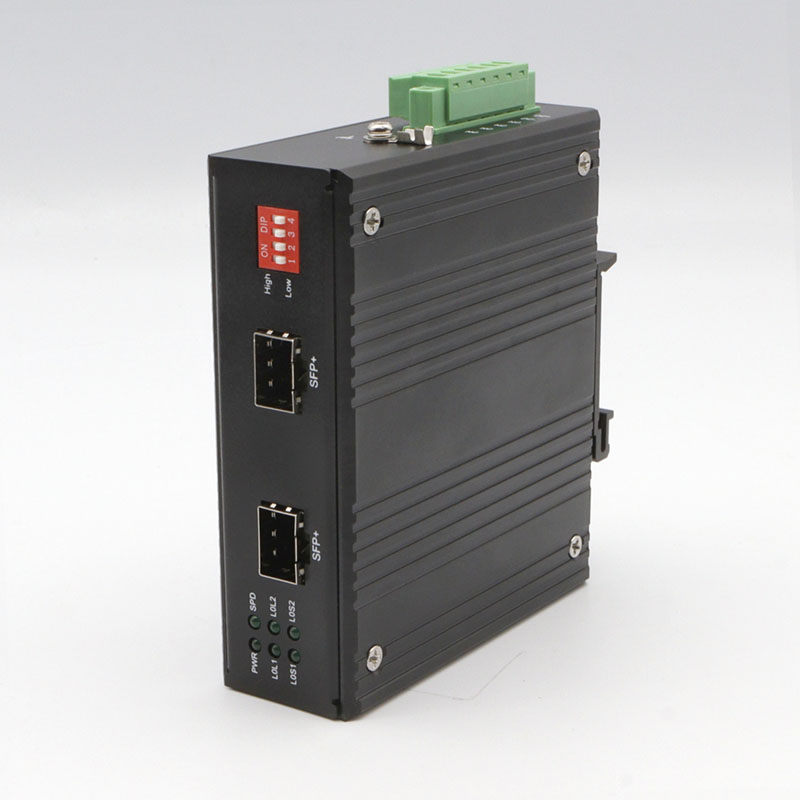
Our WT-F2F-WSFP 10G SFP+ Wavelength Converter is a DIN-rail type solution designed for industrial and professional applications. It supports transparent transport with very low delay, helping maintain efficient communication between different optical network segments. The device also integrates a 3R function, including regeneration, reshaping, and retiming, to improve signal quality during transmission.
Another important feature is wavelength flexibility. The WT-F2F-WSFP supports ITU-T prescribed DWDM and CWDM wavelengths, allowing users to build customized optical communication networks according to their specific requirements. It also supports DDM functionality, enabling users to monitor optical parameters and improve network management efficiency.
The device supports hot plugging, allowing maintenance and installation operations to be performed more conveniently without interrupting the entire network system. Full-state LED display functions also provide clear operational information, helping technicians quickly identify equipment status.
Supporting Industrial and Enterprise Network Upgrades
As digital transformation continues, businesses are investing in communication systems that require greater speed, reliability, and scalability. A 10G media converter helps organizations achieve these goals by connecting different network technologies in a cost-effective way.
Industrial environments especially benefit from this technology. Equipment located in factories, substations, and outdoor facilities often requires stable data communication under challenging conditions. DIN-rail type converters are designed for easy installation in industrial control cabinets, making them suitable for space-limited applications.
In addition, the ability to support hot swapping and advanced monitoring features helps reduce maintenance difficulties. Network operators can manage infrastructure more efficiently while minimizing downtime risks. This is especially important for industries where continuous operation is essential.
For enterprise networks, media converters provide flexibility during infrastructure upgrades. Companies can introduce high-speed fiber connections without replacing every existing Ethernet device. This approach reduces project costs while creating a foundation for future network expansion.
Choosing the Right Solution for Future-Ready Networks
As network requirements continue to increase, companies need connectivity solutions that can support both current operations and future expansion. A reliable 10G media converter should provide strong transmission performance, compatibility with different optical standards, and convenient management features.
We understand that every network project has unique requirements. From industrial communication systems to enterprise infrastructure, selecting the right conversion equipment can directly influence network stability and long-term performance. High-quality components, strict testing processes, and advanced technical capabilities are essential for ensuring reliable operation.
At Wintop, we focus on developing professional networking solutions that help customers overcome connectivity challenges. We are a trusted network equipment supplier and national high-tech enterprise specializing in the R&D, production, and sales of optical modules and switches. Our factory provides reliable fiber-optic network equipment for more than 1,000 smart substation deployments across 40+ countries, supported by over 60 core technology patents and rigorous industrial-grade quality standards.
Our WT-F2F-WSFP 10G SFP+ Wavelength Converter is designed to deliver efficient fiber-Ethernet interconnection with features including transparent transport, low delay performance, DWDM/CWDM wavelength support, DDM monitoring, and convenient DIN-rail installation. Contact Wintop today to discover advanced networking solutions that strengthen your fiber communication infrastructure.