
What Thermal and Power Design Factors Matter Most for 10G SFP Transceivers?
High-speed network communication has become a fundamental requirement for modern enterprises, data centers, and industrial systems. As bandwidth demands continue to increase, optical modules must deliver faster transmission speeds while maintaining stable operation, efficient power consumption, and reliable thermal performance. For network equipment designers and system integrators, understanding thermal and power design considerations in a 10G SFP transceiver is essential for building dependable communication infrastructures.
When we develop optical communication solutions, we focus on balancing transmission performance with energy efficiency and long-term reliability. A well-designed 10G SFP transceiver needs to manage heat generation, power requirements, and signal integrity simultaneously to support demanding network applications.
Why Thermal Management Matters in 10G SFP Transceiver Applications
Thermal management directly affects the stability and lifespan of optical communication components. During operation, key components such as laser transmitters, photodetectors, and integrated circuits generate heat. If this heat is not properly controlled, excessive temperature increases may influence optical performance and reduce module reliability.
A professional 10G SFP transceiver must be designed with efficient heat dissipation capabilities. Compact optical modules have limited internal space, making thermal optimization a significant engineering challenge. Poor thermal control may result in higher power consumption, unstable optical output, and reduced operating life.
For network equipment manufacturers and system developers, selecting modules with optimized thermal characteristics helps maintain consistent performance. Effective thermal design also supports deployment in environments where equipment operates continuously or under heavy data loads.
Power Efficiency Design for High-Speed Optical Modules
Power consumption is another important factor when implementing high-speed network systems. Large-scale deployments may involve hundreds or thousands of optical modules, meaning even small differences in power usage can significantly affect operational costs and cooling requirements.
A high-quality 10G SFP transceiver should provide strong transmission capability while maintaining low power consumption. Efficient circuit design, optimized laser operation, and advanced component selection all contribute to better energy efficiency.
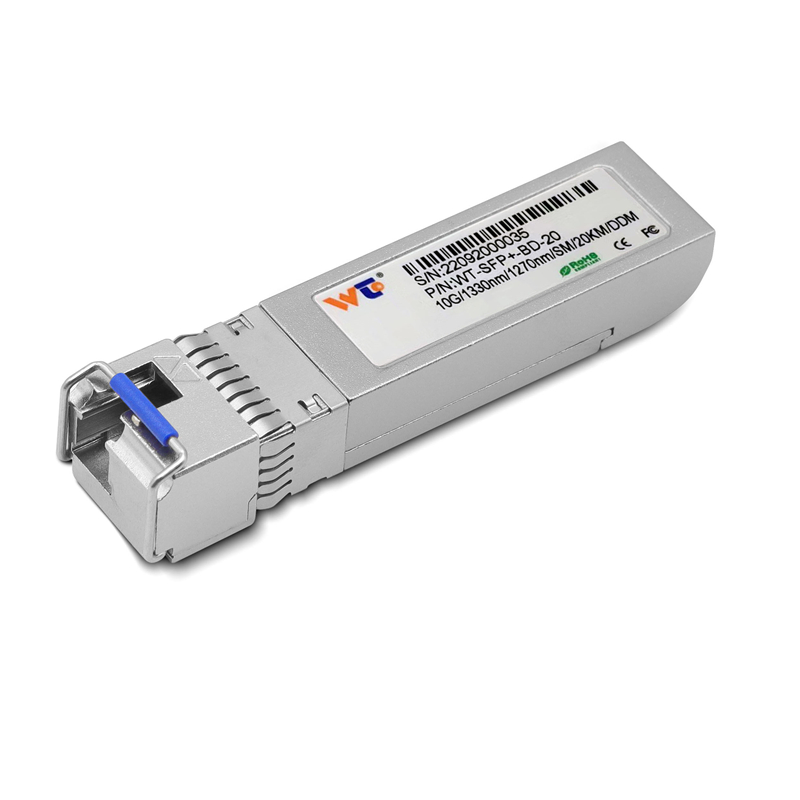
Our WT-SFP+-BD-20 10G SFP+ BD Transceiver is designed with power efficiency in mind. The module operates with a +3.3V single power supply and has power dissipation of less than 1W, helping network systems reduce overall energy consumption while maintaining reliable 10 Gbps-class communication.
Low power consumption not only lowers electricity costs but also reduces heat generation inside network equipment. This creates a more stable operating environment and simplifies thermal management for switches, routers, and other communication devices.
Key Design Features That Improve Optical Module Reliability
Beyond thermal and power performance, optical module reliability depends on multiple design factors. The transmitter and receiver components must work together precisely to maintain stable signal transmission over long distances.
The WT-SFP+-BD-20 uses a 1270nm (1330nm) DFB laser and PIN-TIA photodetector to support efficient optical communication. With transmission distances of up to 20km over single-mode fiber (SMF), the module is suitable for applications requiring reliable long-distance connectivity.
The module supports data links up to 11.3Gbps and adopts an SFP+ package with an SC connector. These specifications allow it to meet the requirements of high-speed network environments while maintaining compatibility with common optical communication infrastructures.
Another important consideration is electromagnetic performance. Optical modules used in professional networking systems need strong protection against interference. Features such as low EMI performance and excellent ESD protection help maintain stable operation in complex environments.
Digital Monitoring and Standards Compliance for Better Management
Modern network systems require greater visibility into equipment status. Digital diagnostic monitoring functions allow administrators to evaluate module conditions and identify potential issues before they affect network performance.
Our 10G SFP transceiver solutions support a 2-wire interface with integrated Digital Diagnostic Monitoring (DDM). This capability enables real-time monitoring of important parameters, helping engineers manage network health more effectively.
Compliance with industry standards is also essential for ensuring compatibility and reliability. The WT-SFP+-BD-20 complies with SFF-8472 SFP+ MSA, SFP+ SFF-8431, and SFF-8432 standards. These standards help ensure that the module can integrate smoothly with compatible networking equipment.
The module also meets RoHS requirements and follows IEC-60825 laser safety standards, supporting safer and more environmentally responsible deployment.
Selecting the Right Optical Module for Future Network Expansion
As network infrastructure continues to evolve, businesses need optical solutions that can support increasing bandwidth requirements while maintaining operational efficiency. Thermal and power design should be considered during the early stages of network planning to avoid future performance limitations.
When choosing a 10G SFP transceiver, companies should evaluate transmission distance, power consumption, environmental conditions, compatibility, and management features. A module that balances these factors can help reduce maintenance requirements and improve long-term network reliability.
For data centers, enterprise networks, and industrial communication systems, reliable optical modules provide the foundation for stable connectivity. By selecting products designed with advanced thermal control and efficient power management, businesses can create networks that deliver consistent performance even under demanding conditions.
Partner with Wintop for Advanced Optical Communication Solutions
The development of high-performance networks requires optical modules that combine speed, efficiency, and reliability. Through careful thermal management and power optimization, a well-designed 10G SFP transceiver can support stable communication while reducing energy consumption and improving system durability.
We at Wintop are a trusted network equipment supplier and national high-tech enterprise specializing in the R&D, production, and sales of optical modules and switches. We provide professional optical communication products, including SFP transceiver modules and industrial Ethernet switches, designed for reliable data transmission in various applications. Our WT-SFP+-BD-20 10G SFP+ BD Transceiver features up to 20km transmission on SMF, less than 1W power dissipation, Digital Diagnostic Monitoring, strong EMI protection, and compliance with major industry standards.
If you are looking for a dependable 10G SFP transceiver solution to improve network performance and efficiency, contact Wintop today. We are ready to provide high-quality optical communication products and customized solutions to support your next-generation network infrastructure.